Laser Eye Treatment – SLT & YAG | Barossa Eye Clinic Gawler
At Barossa Eye Clinic in Gawler, South Australia, we understand the importance of clear vision and optimal eye health. Our dedicated ophthalmologists, Dr. Deric De Wit and Dr. Andrew Laming, offer advanced laser eye treatments, including Selective Laser Trabeculoplasty (SLT) and YAG Laser Capsulotomy, to address a range of conditions. These procedures are vital tools in preserving and restoring sight for our patients across the Barossa Valley and surrounding regions. If you are seeking expert laser eye treatment Gawler SA, our clinic provides compassionate and state-of-the-art care.
What is Laser Eye Treatment (SLT & YAG)?
Laser eye treatments in ophthalmology utilise focused light energy to perform precise surgical interventions or therapeutic modifications within the eye. Unlike refractive laser surgery (like LASIK or PRK) which reshapes the cornea to correct vision, SLT and YAG lasers are used for specific medical conditions affecting the internal structures of the eye. These procedures are performed in-office, are minimally invasive, and typically require only topical anaesthesia.
Selective Laser Trabeculoplasty (SLT)
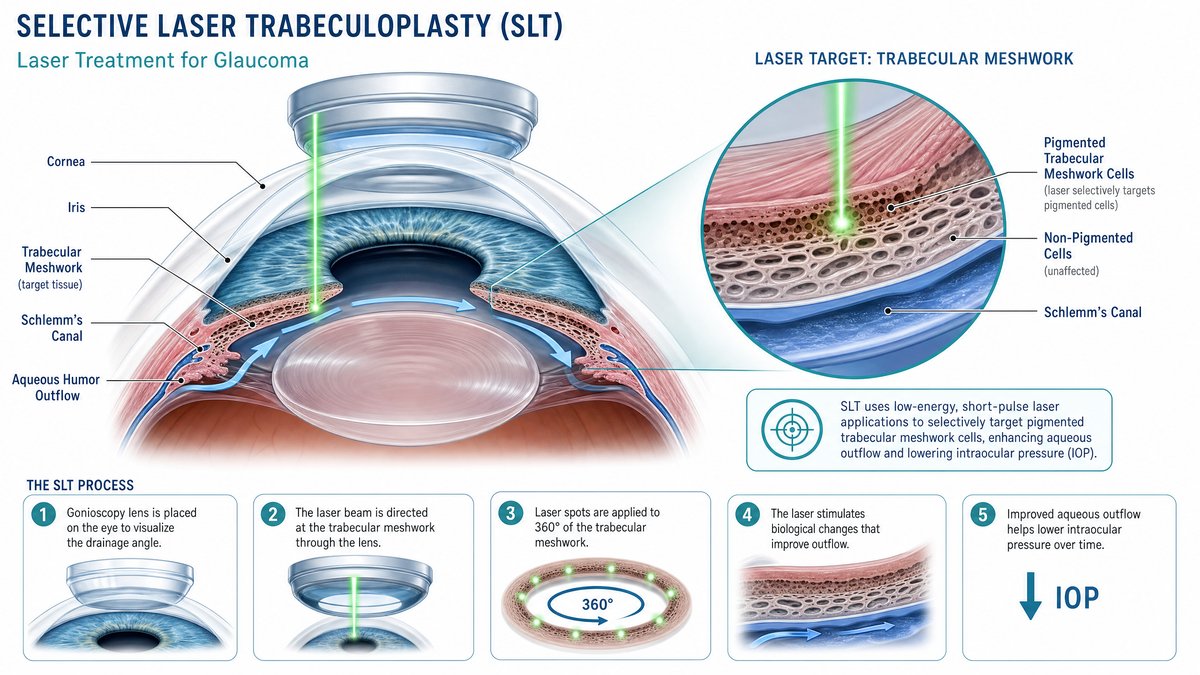
SLT is a gentle, non-invasive laser procedure primarily used to treat open-angle glaucoma, a condition characterised by increased pressure inside the eye (intraocular pressure or IOP). The laser targets specific cells in the eye’s drainage system (the trabecular meshwork) to improve fluid outflow, thereby reducing IOP. It is called ‘selective’ because it only affects pigmented cells, leaving surrounding tissue undamaged, and can often be repeated if necessary.
YAG Laser Capsulotomy
YAG laser capsulotomy is a common and highly effective procedure performed after cataract surgery. While cataract surgery removes the cloudy lens, a thin membrane (posterior capsule) that supports the new intraocular lens can sometimes become cloudy over time, causing vision to blur again. This condition is known as posterior capsular opacification (PCO), often referred to as a ‘secondary cataract’. The YAG laser creates a small, clear opening in this cloudy capsule, restoring sharp vision.
Symptoms Addressed by Laser Eye Treatment
The symptoms that lead to the recommendation of SLT or YAG laser treatment are distinct, reflecting the different conditions they address:
- For SLT (Glaucoma): Early-stage glaucoma often presents with no noticeable symptoms, which is why regular eye examinations are crucial. As the disease progresses, patients may experience gradual peripheral vision loss, tunnel vision, or halos around lights. SLT aims to prevent further vision loss by controlling eye pressure.
- For YAG Laser Capsulotomy (PCO): Patients who develop PCO after cataract surgery will typically notice a gradual return of symptoms similar to their original cataract, including blurred vision, glare, difficulty with night driving, and reduced contrast sensitivity. These symptoms indicate that the posterior capsule has become cloudy and is impeding light from reaching the retina.
Causes/Risk Factors Leading to Laser Eye Treatment Needs
Understanding the underlying causes and risk factors can help in early detection and management:
- For SLT (Glaucoma): The primary cause of open-angle glaucoma is a malfunction in the eye’s drainage system, leading to a build-up of aqueous humour and increased IOP. Risk factors include age (over 60), family history of glaucoma, African or Hispanic ancestry, high internal eye pressure, certain medical conditions (like diabetes, heart disease, high blood pressure, and sickle cell anaemia), and extreme nearsightedness or farsightedness.
- For YAG Laser Capsulotomy (PCO): PCO is a natural healing response of the eye after cataract surgery. It occurs when residual lens epithelial cells migrate and proliferate on the posterior capsule, causing it to become opaque. While it can happen to anyone who has had cataract surgery, some factors may increase the likelihood, such as younger age at the time of cataract surgery, certain types of intraocular lenses, and inflammatory eye conditions.
Diagnosis for Laser Eye Treatment Eligibility
A comprehensive eye examination by an ophthalmologist is essential to determine the need for and suitability of laser eye treatment. At Barossa Eye Clinic, our diagnostic process is thorough:
- For Glaucoma (leading to SLT): Diagnosis involves measuring intraocular pressure (tonometry), examining the optic nerve for damage, assessing the drainage angle (gonioscopy), and performing visual field tests to detect peripheral vision loss. Optical Coherence Tomography (OCT) scans are also used to evaluate the thickness of the retinal nerve fibre layer.
- For PCO (leading to YAG Capsulotomy): Diagnosis is straightforward and involves a slit-lamp examination. The ophthalmologist can clearly visualise the cloudy posterior capsule behind the intraocular lens, confirming that PCO is the cause of the patient’s blurred vision.
Treatment: Understanding SLT and YAG Laser Procedures
Both SLT and YAG laser treatments are outpatient procedures performed at our Gawler clinic, designed for patient comfort and efficiency.
Selective Laser Trabeculoplasty (SLT) Procedure
Before an SLT procedure, eye drops are administered to constrict the pupil and numb the eye. A special contact lens is then placed on the eye, allowing the ophthalmologist to precisely aim the laser at the trabecular meshwork. The laser delivers short pulses of low-energy light, which stimulates the cells to improve drainage. The procedure typically takes only a few minutes, and patients can usually resume normal activities shortly after. IOP reduction typically occurs over several weeks.
YAG Laser Capsulotomy Procedure
Similar to SLT, dilating and numbing eye drops are used before a YAG laser capsulotomy. The patient sits at a slit lamp, and the ophthalmologist uses the YAG laser to create a small, central opening in the cloudy posterior capsule. This allows light to pass through clearly to the retina, immediately improving vision. The procedure is quick, painless, and highly effective, with vision improvement often noticed within hours.
When to Seek Help from Barossa Eye Clinic
If you are experiencing any changes in your vision or have concerns about your eye health, it is crucial to seek professional advice. For residents of the Barossa Valley, Gawler, and wider South Australia, Barossa Eye Clinic is here to help. If you have been diagnosed with glaucoma and are exploring treatment options, or if your vision has become cloudy again after cataract surgery, please do not hesitate to contact us. Early intervention can significantly impact the outcome of many eye conditions.
Frequently Asked Questions about Laser Eye Treatment
Is laser eye treatment painful?
Both SLT and YAG laser procedures are generally not painful. Numbing eye drops are used to ensure comfort. Patients may experience a mild pressure sensation or a brief flash of light during the procedure, but significant pain is rare.
How long does recovery take?
Recovery from both SLT and YAG laser treatments is typically very quick. Most patients can resume their normal activities the same day. You may experience some temporary blurriness, mild irritation, or light sensitivity, which usually resolves within a day or two. Follow-up appointments are scheduled to monitor progress.
Are there any risks associated with these laser treatments?
While both procedures are considered very safe and effective, as with any medical intervention, there are minor risks. These can include temporary increases in eye pressure, inflammation, or, very rarely, retinal detachment or damage to the intraocular lens. Your ophthalmologist at Barossa Eye Clinic will discuss all potential risks and benefits with you during your consultation.
Ready to Discuss Your Eye Health?
If you are experiencing vision changes or have been advised to consider laser eye treatment, the expert team at Barossa Eye Clinic is here to provide comprehensive care. We serve patients from Gawler, the Barossa Valley, and throughout South Australia, offering advanced diagnostic and treatment options. No referral needed — call 1300 107 393 to schedule your consultation with Dr. De Wit or Dr. Laming and take the first step towards clearer vision.
Related Conditions:
Clinical Disclaimer: The information provided on this page is intended for general educational purposes only and does not constitute medical advice. It is not a substitute for professional medical diagnosis, treatment, or care. Always seek the advice of a qualified healthcare provider, such as an ophthalmologist, for any questions you may have regarding a medical condition or treatment. Individual results may vary, and the suitability of any treatment should be discussed with your eye care specialist. Barossa Eye Clinic does not endorse any specific products or services mentioned herein. For personalised medical advice, please consult with Dr. Deric De Wit or Dr. Andrew Laming at Barossa Eye Clinic.